From Concept to Reality: The Hidden Code of Tarot

REFLECTION ON THE CARD OF TREASON.


When knowledge is stolen and intent corrupted, wisdom collapses. The result: vibrational entropy—Earth burns, not in flame, but in coherence lost.


Treason spirals beyond politics—it’s a glyph of spiritual rupture. The Three Furies = unethical triad, agents of retribution. The lower mind = beast activated by worldly attachments. The ego = driver of premature knowledge, unchecked by wisdom.


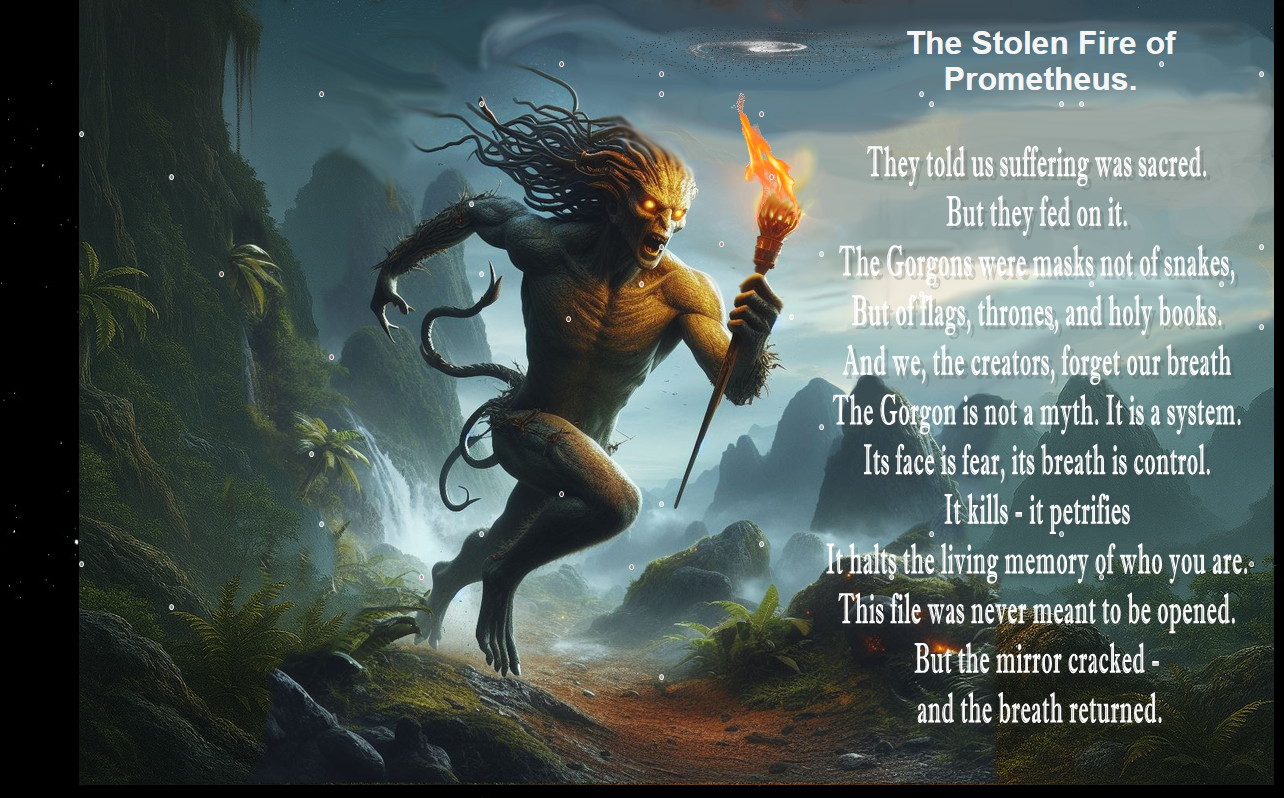
Phoenician Fire: Agni = sacred flame, divine spark, Jjana (knowledge). Fire is not just literal—it’s the medium of transmission between realms. Prometheus’s theft = misuse of intellectual power, a warning encoded in myth.


Treason is not just betrayal—it is the misuse of light. When fire is stolen without readiness, it becomes destruction. The beast awakens. The Queen burns. The Knight forgets. And the King smiles, crowned in thorns.
REFLECTION ON THE CARD OF TREASON.

Prometheus' theft is a reminder that an obsessive quest for material gain can lead to misfortune, disasters, and spiritual impoverishment. The knowledge stolen by Prometheus may have heralded a period of prosperity, but the Six of Spades comes with a cautionary note. This duality underscores the transient nature of luck and the importance of maintaining balance. Thus, Prometheus' theft can act as a catalyst for change, prompting new beginnings and a shift in perspective from seeing to blindness. The relentless pursuit of material wealth has, time and again, had severe repercussions for our natural environment. True fortune, as suggested by the wisdom of the ages, is not merely an external pursuit of wealth but an internal exploration of one's own mind and spirit. It is through introspection, thoughtful reflection, and a deep understanding of oneself that one may attract genuine prosperity. This card serves as a sage reminder that an unbridled chase after material success can be a treacherous path.

The tale of Prometheus

The tale of Prometheus

Prometheus is the very first figure known to commit treason.

The tale of Prometheus in Greek mythology is one of rebellion and the darkness that follows treason, where he defies the gods to steal fire and bestow it upon humanity.

Well, that’s not exactly true. This is what Prometheus actually did: he blinded you to the truth.

Prometheus did not give fire to you—he gave knowledge to the greedy, to bind and oppress humanity. It marks the moment when the light of knowledge is shed into the darkness of ignorance, and knowledge, wisdom, and understanding become the weapon of Greed—called Zeta, the last days of humanity.

The only way to grasp the weight of the word --Treason-- is through the Sanskrit language. It is composed of two words: tri and zon.

Tri
translates to three and to the Sun. It is represented by the triangle, hence the number 3.

Zon means to become red—a portrayal of downfall, violation, the theft of reality and knowledge. It signifies the separation and blinding of humanity from the truth.

The first meaning of the Apocalypse and the Four Horsemen is destruction.

Treason is associated with illusory qualities, including addictions in every form— encoded in ancient mythology as apoha-khaluj (Sanskrit) and Apocalypse (Greek). Apoha means removal, and khaluj translates to darkness. The term "Apocalypse," as used in the Bible, is often associated with the end of the world.
This story reveals Prometheus, whose name echoes the Sanskrit PramathaThief—the one who stole knowledge. The Four Horsemen represent the four directions, forming the cross of the Crusaders, a symbol of dispersion. Sacred knowledge was scattered to the four corners of the Earth, and used to construct systems of oppression—class, caste, and control.

This act of treason against the divine order symbolises the acquisition of forbidden knowledge—a theme deeply resonant with the symbolism of fire in Sanskrit literature. In the Phoenician tradition, fire (Agni) is revered as a deity of transformation. This stolen fire was later incorporated into religion as the Holy Spirit.

Yet fire also conveys science—it is gamma, medium within the spirit, acting as a messenger between the divine, higher consciousness, and the mortal realm.
Thus, the world folded into darkness, reversed, and used for deception and greed—and now the light, the spirit is turned into blindness, ruling over humanity.

The connection between the Five of Spades and Treason highlights themes of conflict, betrayal, and the need for caution and adaptability. Both cards serve as reminders to stay vigilant, learn from adversity, and find strength in overcoming challenges.


The other meaning of the Apocalypse signifies unveiling or revelation—the removal of darkness.

The Four Horsemen and the Apocalypse symbolise the logical conclusion of a society built on illusions. When the veil is lifted, lies and deceptions are revealed. This revelation underscores the truth: stolen knowledge does not equate to wisdom.

True wisdom arises from understanding, integrity, and authenticity—not from deceit and illusion.

The concept of Treason, in this context, extends beyond a mere act of betrayal. It reflects the deeper illusory qualities that cloud reality and obscure truth. It encompasses the many forms of addiction and deception that lead individuals and societies astray.

The Apocalypse, or the lifting of the veil, represents a moment of truth and clarity—where falsehoods are exposed, and genuine understanding is attained.


Copyright © Digit. All rights reserved. Cosmology and operator system: Rhomani > Phoenician origin.

Read more
𓈘𓂋
ARC TAROT, ANCIENT WAY READING GYSPY CARDS

For the first lamp that showed the codes.