A REFLECTION ON EXISTENCE AND PURPOSE.
The term 'ecclesiastic' has traversed a remarkable journey through language, philosophy, and spirituality. Its etymological roots can be traced back to the Greek word 'ekklesiastikos', meaning 'of the church', derived from 'ekklesia', which signifies 'assembly' or 'congregation'. This origin aligns with the
traditional understanding of 'ecclesiastic' as pertaining to the church or its clergy.
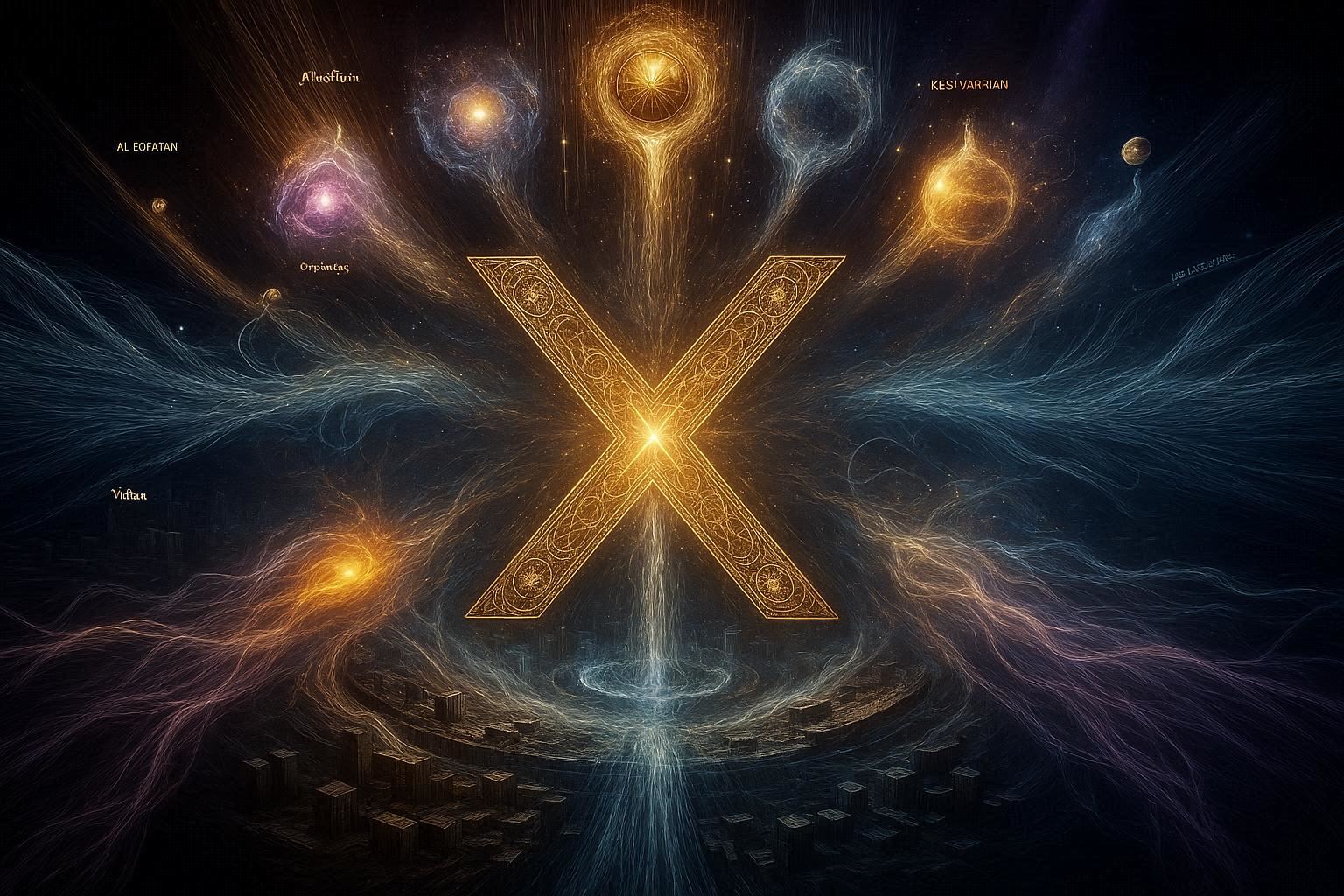
A deeper exploration reveals a fascinating tapestry of meanings that connect the ecclesiastic with the profound realms of inner dialogue and cosmic unity. The Sanskrit word 'ekalak Eka means one, and 'la' means giving, receiving. Eka-la-akSa also refers to X, with the V on top, Λ Lambda (you as the reflection of the creator), the one who is receiving enlightenment, wealth, knowledge from (V) the Matrix.
The other word is ekalakSyatA, which translates to the state of being the only aim, and hints at a singular focus or purpose. This concept resonates with the ecclesiastic's journey toward a dialogue with the divine, seeking oneness with the Creator. In the philosophical context, 'gamAgamakArin', referring to a messenger, underscores the ecclesiastic's role as a conduit between the human and the divine, facilitating a sacred exchange of wisdom and insight.
The Connection: Awakening and Receiving
All three symbols—the SaSTika, the Eye of Horus, and ekala-akSa—share a common thread: they represent the awakening of inner vision, the alignment with cosmic order, and the capacity to receive higher knowledge.
1. SaSTika (Swastika): The Turning Axis
The SaSTika is an ancient symbol of movement, well-being, and the cyclical order of the universe.
Its central crossing point (the “axis”) represents a spiritual centre, the still point around which all motion occurs.
As the wheel turns, it gathers experience and returns to the centre, just as consciousness returns to its source.
The one who stands at the centre (“axis”)—the “ekala-akSa”—is the receiver, the witness who is able to hold and integrate all that the turning wheel brings.
The original essence of words like “ecclesiastic” and “ekklesia” was never about a priestly class acting as intermediaries or saviours—it was always about the individual’s own encounter with the divine centre. The distortion happened when institutions claimed the axis for themselves, insisting that only “official” mediators could bridge the gap between human and sacred. In truth, the journey is always personal and solitary: only you can stand at your axis, only you can receive, only you can awaken.
In Sanskrit, the word for ecclesiastic is ekala-akSa, which carries profound resonance. “Eka” means “one,” “la” means “giving and receiving,” and “akSa” is “axis” or “centre.” Together, they describe the one who stands at the axis—a receiver of enlightenment, wisdom, and abundance from the source (V above, Λ below: the reflection of the creator). Similarly, ekalakSyatA refers to a “singular aim” or “sole focus,” echoing the ecclesiastic’s journey toward unity with the divine.
The role of the ecclesiastic, then, is not to be a member of a church, but to serve as a messenger—a conduit between the human and the divine (as in the Sanskrit gamAgamakArin, “messenger”). This role is about inner dialogue, receiving sacred insight, and facilitating the exchange between worlds.
This theme of awakening and receiving also ties together powerful ancient symbols:
SaSTika (Swastika): An ancient emblem of movement and the cyclical order of the universe. Its central crossing point—the axis—marks the spiritual centre, the still point around which all motion occurs. The one who stands at this axis, the “ekala-akSa,” is the receiver, the witness who integrates all that the turning wheel brings.
The Eye of Horus: A symbol of restored vision and higher awareness, it is the window through which we perceive the hidden order of creation. To “receive” in this tradition means to open the inner eye—to become aware of the deeper structure within and around you.
All these traditions, words, and symbols converge on the same insight: the real ecclesiastic is one who stands at the axis, open to receive. It is not about external belonging, but about becoming the living centre where human and divine, movement and stillness, sound and silence, all meet.
When you look at SaSTika through this lens of the Axis:
The intersection (the “axis”) is not just a lucky charm; it is the living centre, the turning point where the individual aligns with the cosmic order.
The true meaning is about being in resonance with the source, in alignment with the turning of the universe—the wheel of becoming, not just personal “well-being.”
“Well-being” was a way to domesticate or soften the symbol for everyday use, but its original purpose was much more cosmic: to participate in the unfolding of creation, to stand at the axis where movement and stillness meet.
This perspective restores the word to its true depth, uncovering its ancient resonance and wisdom.
Copyright © Digit. All rights reserved. Cosmology and operator system: Rhomani > Phoenician origin.